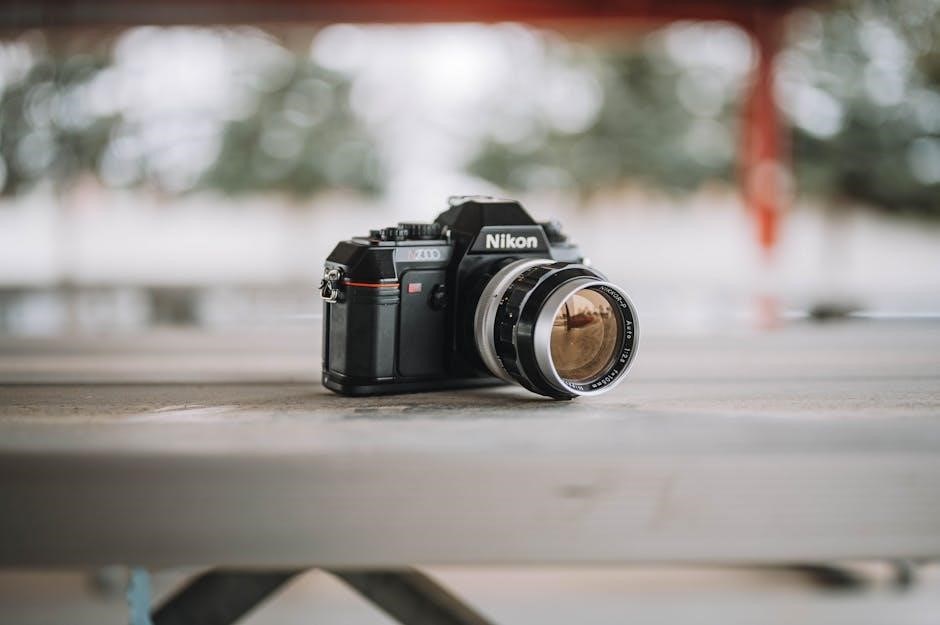
Nikon’s D5200 offers a fantastic entry into DSLR photography, and this documentation – a manual and PDF reference – will help you master its features.
This manual provides essential instructions for optimal camera use, ensuring all users understand its capabilities and settings for stunning results.
What’s Included in the Documentation
The complete documentation package for your Nikon D5200 consists of two key components designed to guide you through every aspect of camera operation. Firstly, you’ll receive a printed Users Manual – this booklet provides a comprehensive, step-by-step introduction to the camera’s features and functions. It’s designed for quick reference and easy understanding, perfect for beginners.
Secondly, a detailed Reference Manual is available in PDF format. This digital manual delves deeper into advanced settings, troubleshooting, and technical specifications. It includes a Quick Start Guide, Basic and Advanced operation instructions, a full explanation of Menu Functions, Custom Settings options, and solutions to common issues. You can also utilize the Nikon Manual Viewer app for convenient offline access on your mobile devices.
About This Instruction Manual Plan
This instruction manual is structured to facilitate a smooth learning curve for Nikon D5200 users, regardless of their prior photography experience. It begins with fundamental setup and operation, gradually progressing to more advanced techniques. The plan prioritizes clarity and accessibility, utilizing concise language and illustrative examples.
We’ve organized the content to mirror the camera’s menu system, allowing you to easily locate information relevant to specific settings. Supplemental resources, like the downloadable PDF manual and the Nikon Manual Viewer app, are highlighted to provide multiple learning pathways. This approach ensures you can maximize your D5200’s potential and enjoy the art of photography.

Getting Started with Your D5200
Begin your photographic journey by unpacking your Nikon D5200, charging the battery, and inserting a memory card – essential first steps for operation!
Unboxing and Initial Setup
Upon opening your Nikon D5200 box, carefully remove all components. Verify the contents against the included documentation to ensure everything is present – the camera body, battery, charger, strap, and various cables.
Before powering on, attach the strap securely to the camera body for safe handling. Familiarize yourself with the basic layout of buttons and dials. Initial setup involves selecting your language, date, and time.
The camera will guide you through this process on the LCD screen. Ensure you have a compatible memory card inserted to store your photos and videos. Proper unboxing and setup are crucial for a smooth start to your photography experience.
Charging the Battery
To charge your Nikon D5200 battery, connect the provided charger to a standard wall outlet. Insert the battery into the charger, ensuring correct polarity – typically indicated by a diagram on the charger itself.
The charger’s indicator light will illuminate, usually red while charging and green when fully charged. A full charge typically takes several hours, but avoid overcharging.
Nikon recommends using only the supplied charger to prevent damage to the battery. A fully charged battery provides ample power for numerous shots, allowing you to focus on capturing stunning images without interruption. Always handle the battery with care.
Inserting Memory Card
Before you begin shooting with your Nikon D5200, you must insert a compatible memory card. Locate the memory card slot, typically found on the side of the camera body. Open the card slot cover.
Insert the memory card – SD or SDHC are commonly supported – into the slot, ensuring it’s oriented correctly. Gently push until it clicks into place. Do not force it.
Close the card slot cover securely. The camera will recognize the card, and you can confirm its presence in the camera’s menu. Always eject the card safely through the menu before removing it physically.
Understanding the Camera Body
Familiarize yourself with the Nikon D5200’s layout, including front, rear, and top panel controls, to efficiently navigate its functions and settings for optimal photography.
Front and Rear Panel Overview
The Nikon D5200’s front panel houses essential components like the lens mount, allowing for interchangeable lenses to capture diverse perspectives. You’ll also find the depth-of-field preview button and the AF-assist illuminator.
Turning to the rear panel, the 3.0-inch LCD screen dominates, providing a clear view for composing shots and reviewing images. Adjacent to the screen are buttons for menu navigation, image playback, and information display. The control dial facilitates quick adjustments to settings, while the four-way controller enables precise menu selection. The rear panel also features ports for connecting external devices, such as a microphone or remote shutter release, expanding the camera’s functionality.
Understanding these elements is crucial for efficient operation.
Top Panel Controls and Functions
The Nikon D5200’s top panel is command central, featuring the mode dial for selecting shooting modes – Auto, Scene, Program, Aperture-priority, Shutter-priority, and Manual; The on/off switch and shutter button are conveniently located for immediate access.
A dedicated video record button initiates movie recording with a simple press. The control dial allows for swift adjustments to settings like aperture, shutter speed, or exposure compensation, depending on the selected shooting mode. Additionally, the top panel includes the built-in flash control, enabling you to raise or lower the flash unit as needed. Familiarizing yourself with these controls streamlines your shooting process.
Mastering these functions enhances your creative control.
Mode Dial Explained
The Nikon D5200’s mode dial offers versatile shooting options. “Auto” mode simplifies photography, letting the camera handle all settings. “Scene” mode provides presets for portraits, landscapes, and more. “P” (Program) allows some control while the camera manages aperture and shutter speed.
“A” (Aperture-priority) lets you set the aperture for depth of field control, while “S” (Shutter-priority) controls motion blur. “M” (Manual) grants full creative control over both aperture and shutter speed. Understanding each mode empowers you to achieve desired photographic effects. Experimenting with these settings unlocks your artistic potential and enhances image quality.

Basic Camera Operations
Mastering shooting and focusing modes, alongside understanding exposure – aperture, shutter speed, and ISO – are fundamental to capturing great images with your Nikon D5200.

Shooting Modes: Auto and Scene
The Nikon D5200 simplifies photography with its Auto mode, intelligently selecting settings for various conditions. For more control, explore Scene modes like Portrait, Landscape, and Sports.
Portrait mode creates a blurred background, emphasizing your subject. Landscape prioritizes sharpness and vibrant colors for expansive views. Sports utilizes faster shutter speeds to freeze action.
These pre-configured settings offer a convenient starting point, allowing you to quickly adapt to different shooting scenarios without manually adjusting complex camera parameters. Experiment with each Scene mode to discover how they enhance your photographs, and learn when to utilize them for optimal results.
Remember to consult the full manual for detailed explanations of each mode’s specific characteristics and recommended usage.
Focusing Modes: Single and Continuous
The Nikon D5200 offers two primary autofocus (AF) modes: Single-servo AF (AF-S) and Continuous-servo AF (AF-C). Understanding their differences is crucial for capturing sharp images.
AF-S is ideal for stationary subjects. The camera focuses once when you half-press the shutter button, locking focus until you fully press to take the picture. This is perfect for portraits or landscapes.
AF-C, conversely, is designed for moving subjects. It continuously tracks the subject’s movement, adjusting focus in real-time. Use this mode for sports, wildlife, or any action photography.
Refer to the manual for customizing AF-area modes alongside these AF-servo modes for even greater control over your focus points.
Understanding Exposure: Aperture, Shutter Speed, and ISO
Mastering exposure is key to great photography with your Nikon D5200. Exposure is controlled by three elements: aperture, shutter speed, and ISO sensitivity.
Aperture (f-stop) controls the lens opening, affecting depth of field – how much of the image is in focus. Lower f-numbers (e.g., f/1.8) create shallow depth of field, ideal for portraits.
Shutter speed determines how long the sensor is exposed to light. Faster speeds freeze motion, while slower speeds allow more light in but can cause blur.
ISO measures the sensor’s sensitivity to light. Higher ISOs are useful in low light but can introduce noise. Consult the manual for optimal settings.

Navigating the Menu System
The Nikon D5200’s menu offers extensive customization. This manual details the menu structure, shooting options, and custom settings for personalized camera control.
Menu Structure Overview
The Nikon D5200’s menu system is logically organized for intuitive navigation. It’s broadly divided into several key sections, each represented by a distinct tab. These include the Setup menu, for general camera settings like date, time, and language; the Shooting menu, controlling image quality and capture settings; and the Custom Settings menu, allowing personalized adjustments to camera operations.
Within each menu, options are further categorized for ease of access. Understanding this hierarchical structure is crucial for efficiently locating and modifying settings. The manual provides a detailed breakdown of each menu item, explaining its function and available options. Utilizing the menu effectively unlocks the full potential of your D5200, enabling you to tailor the camera to your specific shooting needs and preferences.
Customizing Settings
The Nikon D5200 allows extensive customization to match your shooting style. The Custom Settings menu is where you personalize camera functions. You can adjust button assignments, control how the autofocus system behaves, and fine-tune the metering system for optimal exposure.
These settings let you create a workflow that feels natural and efficient. The manual details each customizable option, explaining its impact on camera operation. Saving custom settings as presets allows quick recall for different shooting scenarios. Experimenting with these features unlocks the D5200’s full potential, transforming it from a capable camera into a tool perfectly suited to your individual needs.
Shooting Menu Options
The Nikon D5200’s Shooting Menu is central to controlling image capture. Within this menu, you’ll find options for image quality, size, and file format (RAW or JPEG). Adjust settings for auto-exposure, auto-focus, and flash control. Explore options for multiple exposure photography and time-lapse sequences.
The manual thoroughly explains each setting, detailing how it affects your final images. Understanding these options is crucial for achieving desired creative effects. You can also configure settings related to the viewfinder display and the information shown during live view. Mastering the Shooting Menu unlocks the D5200’s full creative potential.

Advanced Features and Settings
Delve deeper with Nikon’s D5200! Explore Picture Control, White Balance adjustments, and effective flash techniques detailed in the manual for professional results.
Picture Control Settings

Nikon’s D5200 offers Picture Control settings, allowing you to customize the look of your images directly within the camera. These presets – Standard, Neutral, Vivid, Monochrome – influence color, contrast, and sharpness.
The manual details how to select a Picture Control suited to your subject and shooting conditions. You can also fine-tune each preset, adjusting parameters like sharpness, contrast, brightness, saturation, and hue to create a personalized style.
Experimenting with these settings lets you achieve desired results without extensive post-processing. Save custom Picture Controls for consistent image rendering across shoots, streamlining your workflow and enhancing creative control. The PDF manual provides detailed guidance on each setting.
White Balance Adjustment
Accurate color rendition relies on proper white balance. The Nikon D5200 manual explains how to adjust white balance to neutralize color casts caused by different lighting conditions. Auto white balance works well in many situations, but custom settings offer greater control.
Presets like Daylight, Cloudy, Fluorescent, and Incandescent are available. For precise results, use the custom white balance feature, photographing a white or gray card under the specific lighting. The manual details this process.
Understanding white balance ensures your images accurately reflect the scene’s colors, avoiding unwanted tints. The PDF manual provides in-depth explanations and troubleshooting tips for achieving natural-looking colors.
Using Flash Effectively
The Nikon D5200’s built-in flash and compatibility with external units are covered in the manual. Learn to utilize flash for improved illumination in low-light scenarios and to freeze motion. The manual details flash modes: Auto, Auto with Red-Eye Reduction, Fill-Flash, Slow Sync, and Manual.
Explore flash compensation to fine-tune flash output. The manual explains how to adjust settings for balanced exposures. For creative effects, experiment with bouncing the flash off ceilings or walls. The PDF manual offers advanced techniques and troubleshooting for flash photography.
Mastering flash control enhances your images, adding brightness and clarity when natural light is insufficient.

Troubleshooting Common Issues
The manual addresses frequent problems like error messages, a camera that won’t power on, and image quality concerns, offering clear solutions.
Error Messages and Solutions
Nikon D5200 error messages indicate specific camera issues, and the manual provides detailed explanations and troubleshooting steps for each. Common errors include “Memory card error,” suggesting a card issue or incompatibility; “Lens error,” indicating a problem with lens communication; and “Battery exhausted,” requiring a charge or replacement.
The manual guides users through solutions like re-inserting the memory card, cleaning the contact points, trying a different lens, or ensuring the battery is correctly installed. It also advises checking the Nikon support website for more complex errors or if the problem persists after attempting the suggested fixes. Understanding these messages and following the manual’s guidance can often resolve issues quickly.
Camera Not Turning On
If your Nikon D5200 fails to power on, the manual recommends several checks. First, ensure the battery is fully charged and correctly inserted, verifying the lock release is engaged. Next, try a different, known-working battery to rule out a battery defect. Inspect the battery contacts within the camera for any dirt or damage, cleaning them gently if necessary.
The manual also suggests removing the memory card and attempting to power on the camera; a faulty card can sometimes prevent startup. If these steps fail, consult the Nikon support resources or a qualified technician, as the issue may indicate an internal problem requiring professional attention.
Image Quality Problems
Should your Nikon D5200 images exhibit quality issues, the manual directs users to examine several factors. Begin by verifying the image size and quality settings within the menu; lower settings result in smaller files but reduced detail. Ensure the lens is clean and free of smudges, as these directly impact sharpness.
Check the ISO setting – higher ISOs introduce noise. Confirm proper focusing; blurry images indicate focus errors. The manual also advises reviewing Picture Control settings, as these affect color and contrast. If problems persist, consider resetting the camera to factory defaults as a troubleshooting step.

Resources and Further Learning
Expand your D5200 knowledge with the Nikon Manual Viewer app, downloadable PDF versions, and extensive online support forums for helpful tips.
Nikon Manual Viewer App
Nikon provides a convenient way to access your D5200’s documentation directly on your mobile devices through the Nikon Manual Viewer 2 app. Available for both iOS (iPhones, iPads, iPod touch) and Android devices, this application allows you to download and view the camera’s manual offline, eliminating the need for a physical copy or internet connection when you’re on the go.
This is particularly useful for quick reference during shoots or when traveling; Simply visit the App Store or Google Play to download the latest version of the app. Nikon regularly updates the app to ensure compatibility and provide the most current information for all their digital SLR cameras, including the D5200.
Downloading the PDF Manual
For users who prefer a digital, downloadable copy, the Nikon D5200’s comprehensive PDF User Manual is readily available. This manual encompasses a wealth of information, including a Quick Start Guide, detailed Basic and Advanced Operation instructions, a complete Menu Functions overview, Custom Settings explanations, and a Troubleshooting section with specifications.
Accessing the PDF version allows for easy searching and printing of specific sections. It’s an excellent resource for in-depth learning and reference. Several online sources offer the manual for download, ensuring you always have access to the information you need to fully utilize your Nikon D5200.
Online Support and Forums
Beyond the official manuals, a vibrant online community and extensive Nikon support resources are available for D5200 users. Nikon’s website provides dedicated support pages with FAQs, troubleshooting guides, and software downloads.
Numerous photography forums and online communities are populated with D5200 enthusiasts eager to share their knowledge and assist with any questions or challenges you may encounter. These platforms offer a valuable space to learn tips, discuss techniques, and find solutions to common issues, enhancing your overall experience with the camera.